

Thank you for Subscribing to Med Tech Business Review Weekly Brief

BD
Jennifer Lazar, Global Director, New Product Management
The Power of Smart Choices in Medtech Innovation

Jennifer Lazar
Jennifer Lazar has more than 18 years of experience in the life sciences and medical device industry, holding leadership roles in marketing, program management, portfolio management and general management. After eight years in consulting, she joined BD Biosciences, advancing from Business Intelligence to Platform Product Management in Clinical and Research Flow Cytometry. She later played a key role in launching BD FACSymphony systems and integrating Cytognos into BD. Moving to BD’s Medication Management Solutions (MMS), she led Infusion New Product Development and Portfolio Management before returning to BD as Global Director of New Product Management for Instruments, Software and Informatics, driving portfolio strategy and business priorities.
Recognizing Lazar’s expertise in MedTech innovation, this interview explores her approach to product strategy, leadership and delivering solutions that meet real-world healthcare needs.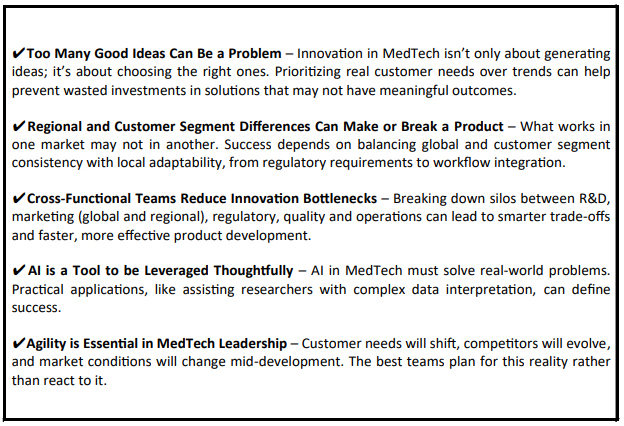 How Has Curiosity Shaped Your Career Story?
Following an impactful 10 years in the consulting industry, I joined the marketing organization at BD, one of the largest MedTech companies in the world, with the desire to be part of a business that significantly impacts patient lives. I was hired due to my background in medical device and life sciences customer insights and strategy, and joining BD would be a great place to develop my skills and grow a successful career.
As a high-potential Marketing Associate, I had the privilege of rapidly expanding my roles and responsibilities. I evolved from driving best practices in market research, competitive insights, and business case development to managing product lines exceeding $100M. My contributions included shaping an impactful roadmap, generating compelling evidence, and enhancing the customer experience. Seeking to broaden my expertise, I pivoted to a role within the program management organization, where I honed my skills in cross-functional leadership, strategic planning, and execution. These experiences have strengthened my ability to deliver innovative solutions for both the business and customers, positioning me as a more well-rounded marketer and platform leader for the future.
Following the success of delivering the early launch of three needle mover programs and completing a successful integration of the Cytognos acquisition, which expanded the BD portfolio in blood cancer diagnostics, immune assessment tests and informatics, I moved from our BD Biosciences business unit (part of our life sciences segment) to the Medication Management Systems (MMS) business unit in the capacity of program director to lead technological advancements in the infusion market, before quickly being elevated to head the BU’s portfolio management to enhance my knowledge of medical devices, product development, portfolio management, and strategy. After successfully implementing improved operating efficiencies, I have returned to BD Biosciences to lead our new instruments and software product portfolio with a focus on flow cytometry to address customer unmet needs and drive profitable growth for the platform.
What are Some of the Hardest Parts of Leading Innovation?
There is no shortage of great, innovative, and impactful ideas driven by our talented BD Biosciences associates, who make up our innovation funnel. The challenge is managing our resources and budget to ensure we focus on innovations that will drive the highest impact on our research, clinical customers (and ultimately patients), and business.
How Has Curiosity Shaped Your Career Story?
Following an impactful 10 years in the consulting industry, I joined the marketing organization at BD, one of the largest MedTech companies in the world, with the desire to be part of a business that significantly impacts patient lives. I was hired due to my background in medical device and life sciences customer insights and strategy, and joining BD would be a great place to develop my skills and grow a successful career.
As a high-potential Marketing Associate, I had the privilege of rapidly expanding my roles and responsibilities. I evolved from driving best practices in market research, competitive insights, and business case development to managing product lines exceeding $100M. My contributions included shaping an impactful roadmap, generating compelling evidence, and enhancing the customer experience. Seeking to broaden my expertise, I pivoted to a role within the program management organization, where I honed my skills in cross-functional leadership, strategic planning, and execution. These experiences have strengthened my ability to deliver innovative solutions for both the business and customers, positioning me as a more well-rounded marketer and platform leader for the future.
Following the success of delivering the early launch of three needle mover programs and completing a successful integration of the Cytognos acquisition, which expanded the BD portfolio in blood cancer diagnostics, immune assessment tests and informatics, I moved from our BD Biosciences business unit (part of our life sciences segment) to the Medication Management Systems (MMS) business unit in the capacity of program director to lead technological advancements in the infusion market, before quickly being elevated to head the BU’s portfolio management to enhance my knowledge of medical devices, product development, portfolio management, and strategy. After successfully implementing improved operating efficiencies, I have returned to BD Biosciences to lead our new instruments and software product portfolio with a focus on flow cytometry to address customer unmet needs and drive profitable growth for the platform.
What are Some of the Hardest Parts of Leading Innovation?
There is no shortage of great, innovative, and impactful ideas driven by our talented BD Biosciences associates, who make up our innovation funnel. The challenge is managing our resources and budget to ensure we focus on innovations that will drive the highest impact on our research, clinical customers (and ultimately patients), and business.
Customer needs and regulatory approaches vary across regions and market segments, making it essential to incorporate diverse inputs when evaluating unmet needs and potential solutions. Striking the right balance between trade-offs is often necessary to achieve a focused and impactful outcome
The articles from these contributors are based on their personal expertise and viewpoints, and do not necessarily reflect the opinions of their employers or affiliated organizations.
